
Challenge. Opportunity. Choice. Excellence. The Future.
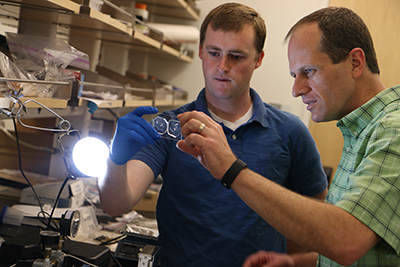
The Department of Mechanical Engineering at the University of Utah offers a premier graduate program within the state. Our graduate students are actively engaged in finding creative solutions to real-life problems. Working with state-of-the-art equipment and guided by faculty members, you can become part of a world-class research team. This leads to big opportunities for our graduates to produce the technology of the future and improve human lives. The University of Utah is consistently ranked among the top American Universities in overall funded research and graduate students are an essential part of every research team. Our nationally recognized faculty, research, and graduate programs provide an environment where fundamentals become reality.
“The mission of the Department of Mechanical Engineering is to conduct innovative research and to provide a world-class education that instill the professional, technical, critical-thinking, and communication skills necessary for students and faculty to make impactful contributions to society.”
The University of Utah is the flagship institution of higher education in Utah. The U currently serves over 31,000 students from all over the country and the world. The U offers over 90 majors at the graduate level. The U has been recognized on a national and global level by being ranked among the top 100 universities in the world.
“U of U Rankings”
- The U of U is the only Research 1 University in the state of Utah;
- The U of U is named the No. 1 research institution for starting technology companies based on university technology (2009 Association of University Technology Managers);
- The U of U is ranked among the top 25 public U.S. Research Universities (2010 Top American Research Universities, Ctr. For measuring University Performance);
- The U of U is ranked No. 34 in the world as a Top Comprehensive Research University (1998 – 2008 Top 100 Large Comprehensive Research Universities in the World, University of Groningen);
- The U of U is ranked No. 47 in the U.S. and No. 82 in the world (2010 Academic Ranking of World Universities, Shanghai Jiao Tong University);
- The U of U is ranked No. 51 in North America and No. 83 in the world (2010 – 2011 Times Higher Education, the World University Rankings);
- The College of Engineering is ranked No. 60 in the nation (2011 U.S. News and World Report, Best Engineering Schools);
- The Department of Mechanical Engineering is ranked No. 67 in the nation (2011 U.S. News and World Report, Best Mechanical Engineering Schools).
Aerospace
The Aerospace Research and Education in the University of Utah’s Department of Mechanical Engineering conducts fundamental and system level research toward next generation aerospace and aeronautical systems. Specific strengths include computational design methods, aerodynamics, compressible flow, combustion, and aeroelasticity. We also offer an undergraduate emphasis in Aerospace Engineering.
Advanced Manufacturing
Advanced Manufacturing Research and Education in the U’s Department of Mechanical Engineering examines materials produced using innovative technologies, and the leveraging of innovative technologies to create existing and new products. Core strengths include additive manufacturing, materials forming, materials joining, and nanomaterials.
Biomechanical Engineering
Biomechanical Engineering Research and education in the U’s Department of Mechanical Engineering is applying mechanics to biological systems, including the study of how the human body responds to the application of force. Core strengths include biomaterials, bionics, medical device design, microfluidics and structure of injury and disease.
Computational Mechanics
Computational Mechanics Research and Education in the University of Utah’s Department of Mechanical Engineering is developing mathematical models to represent physical phenomena and applying modern computing methods to analyze these phenomena. Core strengths include fluids, solids, multiscale materials, and acoustics and vibrations.
Data Science
Data Science Research and Education in the University of Utah’s Department of Mechanical Engineering is developing and applying machine learning and artificial intelligence to generate new models and learn governing equations using simulated or physical data sets.
Environmental Fluid Dynamics
Environmental Fluid Dynamics Research and Education in the University of Utah’s Department of Mechanical Engineering is studying the properties of the Earth’s atmosphere and its relation to the science of fluid dynamics, including large scale simulations and field experiments. Core strengths include dynamics, mechanics, pollutant dispersion, computational analysis, large scale simulations, and atmospheric boundary layers.
Micro Nano
Professors in the Micro/Nano Research Area investigate engineering developments and scientific questions related to the micro- (10-6 m) and nano- (10-9 m) scales. These developments can be related to materials such as 1D or 2D materials (i.e. nanofibers or graphene), biomedical systems such as point-of-care diagnostic devices or biomimetic tissue engineering, sensing and actuation devices such as accelerometers or ultrasound imaging devices, energy and thermal systems such as micro- batteries and fuel cells, manufacturing methods including additive manufacturing, micro-robotics, and much more. The key connecting theme of all Micro/Nano research is that it investigates phenomena that occur at these small scales and/or device implementation methods relevant to these small scales.
Robotics
Robotics Research and Education in the University of Utah’s Department of Mechanical Engineering has close ties with the School of Computing. The research program focuses on design, construction, operation, and use of robots. Core strengths include healthcare robotics, bioinspired design and control, manipulation and motion control, physical human robot interaction, micro/nano robotics, haptic interfaces, VR interfaces, and teleoperation. You can find out more about the Robotics Track here.
Solid Mechanics
Solid Mechanics Research and Education in the U’s Department of Mechanical Engineering is characterizing, designing, and predicting mechanics of soft and hard structures. Core strengths include composites, computational mechanics, fracture and fatigue mechanics, high strain-rate mechanics, and soft tissue biomechanics.
Sustainable Energy
Sustainable Energy Research and Education in the University of Utah’s Department of Mechanical Engineering focuses on developing clean energy systems, including direct energy production, energy storage, and the integration of energy efficient technologies. Core strengths include wind energy, thermophotovoltaic power generation, computational analysis and data sciences, multi-scale heat transfer (nano to geologic scales), and energy storage.
Systems Engineering
Developing, analyzing, optimizing and managing complex engineered systems to improve their productivity and efficiency. We also offer a Systems Engineering Graduate Certificate.
Thermal Science
Thermal Sciences Research and Education in the University of Utah’s Department of Mechanical Engineering studies thermodynamics and heat transfer physics in a wide range of length and time scales that impact engineering and biological applications. Core strengths include microfluidics, computational fluid dynamics, radiative energy transfer, and nanoscale.
Specific Research Topics Include:
- Biomechanical Engineering
- Composite Materials
- Controls
- Design
- Energy Systems
- Ergonomics & Safety
- Fluid Mechanics
- Heat Transfer
- Manufacturing
- Microsystems & Nanosystems
- Thermodynamics
- Robotics
- Solid Mechanics